What is Ultra-Deep Geothermal Energy?
The History of Ultra-Deep Drilling
As explained in FAQ-07 and FAQ-20, to fully understand UDG/EGS, one must distinguish it from traditional geothermal energy systems. UDG/EGS represents a paradigm shift and is fundamentally incomparable to the other categories.
But how 'traditional' is UDG/EGS? From a drilling depth perspective, going this deep has only been attempted once before for research purposes - unsuccessfully - in Russia.
The Kola Superdeep Borehole
(SG-3 - 12.3 km) - Russia (1970-1994)
The Kola Superdeep Borehole reached approximately 12.3 km, still only a fraction of the Earth's crust. Further drilling ultimately became impractical as extreme temperatures and challenging drilling conditions severely limited progress.
The Enthalpy boost!
Targetting exponential results
Enthalpy boost – The Game Changer!: from 374°C and 221 bar, water no longer exists as separate liquid and gas phases, but as a ‘supercritical fluid’. A unique state in which heat and energy conversion proceeds
substantially more efficiently than with conventional steam.
In many stable continental regions, the supercritical temperature regime may require drilling to approximately 12-16 km or more. In highly active geothermal regions such as Iceland, comparable temperatures can occur at only a few kilometres depth.
Source: US Dept. of Energy (DOE) and ARPA-E
The Sustainability of Geothermal Energy
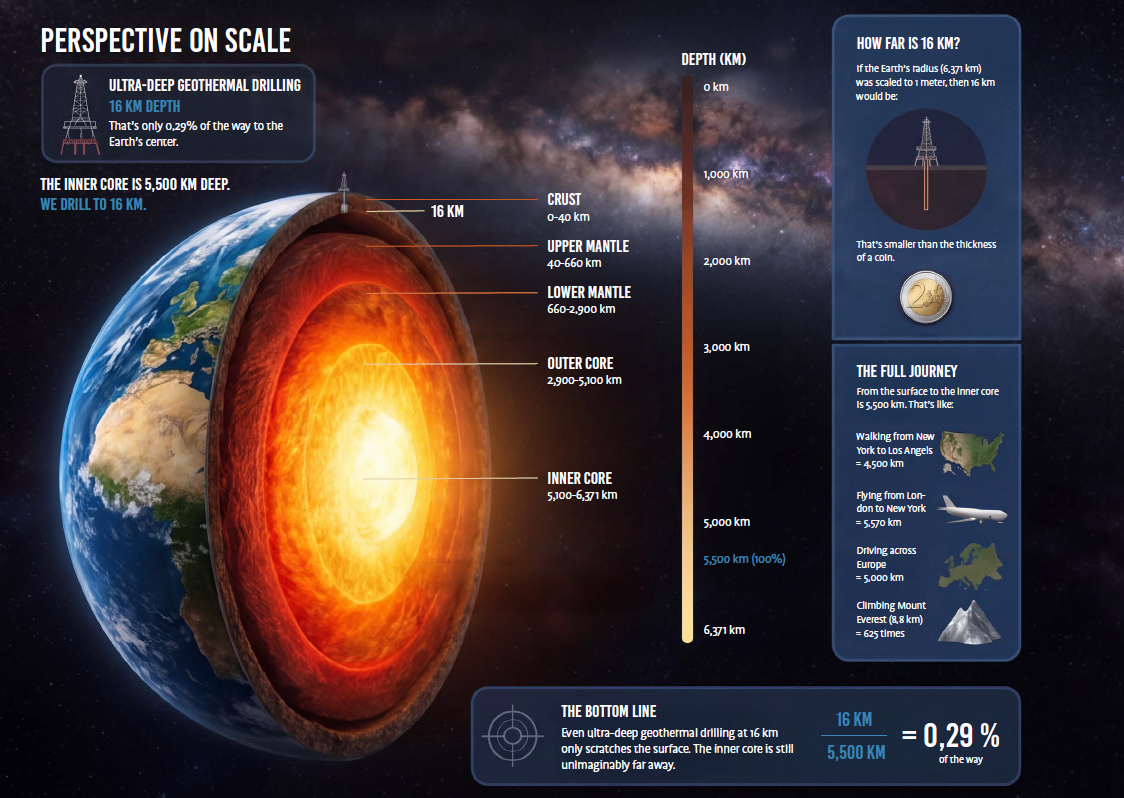
On a human scale the earth's energy is indefinitely and without any impact. A depth of 16 km is still only scratching the earth's surface (0.3% of the distance to the core).
Can Geothermal Energy get depleted like fossil fuels?
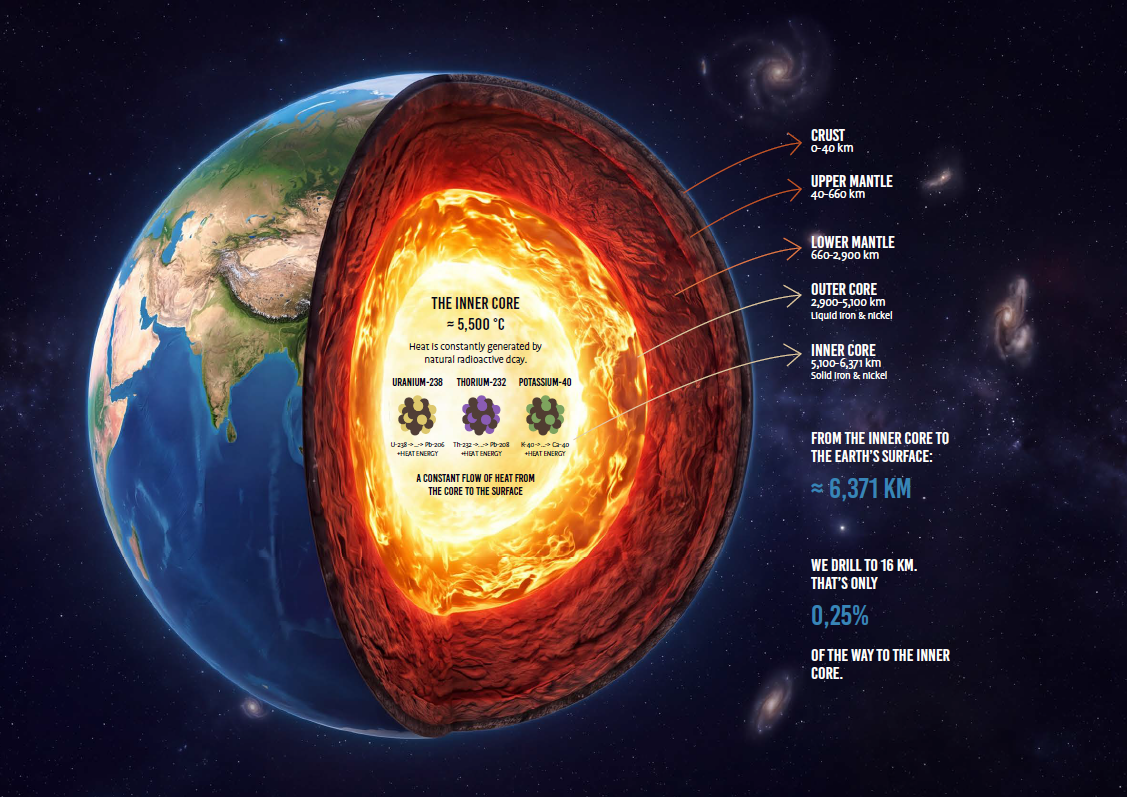
Unlike fossil fuels, Ultra-Deep Geothermal Energy cannot be depleted on human timescales.The Earth contains an immense and continuously replenished thermal reservoir, extending thousands of kilometres beneath our feet.
Ultra-Deep Geothermal Energy - Done Before?
The industry front-runners | Different technologies. Different approaches. One frontier.
Ultra-Deep geothermal is rapidly emerging as one of the most exciting frontiers in clean energy, and the United States - where it is called Enhanced Geothermal Systems (EGS) - is clearly taking a leading position together with Iceland.
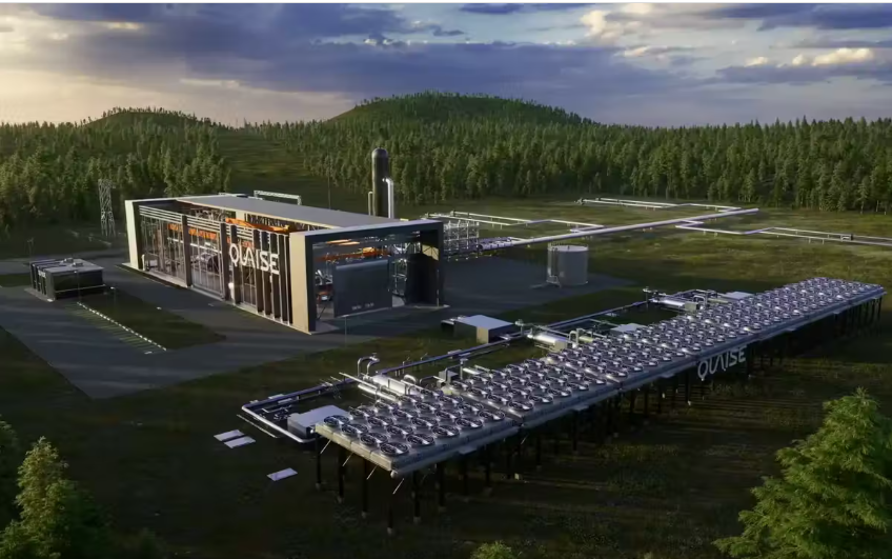
US-based Quaise Energy has already started construction of Project Obsidian in Central Oregon, aiming to demonstrate the world’s first commercial superhot geothermal power plant, initially delivering 50 MW, scaling to 250 MW and ultimately to 1+ GW...!
Using a combination of conventional drilling and its pioneering millimeter-wave drilling technology, Quaise aims to access rock at temperatures above 300°C and unlock geothermal energy on a scale previously considered inaccessible.
Another US-based company starting in 2026 with an ESG-project is Mazama Energy. The Newberry Project in Oregon State, targetting super-hot rock with temperatures over 400°C, is the demonstration of "the hottest EGS to date across the globe. Mazama’s breakthrough at Newberry sets a new global benchmark for geothermal technology and marks a critical step towards delivering low-cost, carbon-free baseload power at terawatt scale at less than USD 5 cents per kilowatt-hour (kWh), which validates the feasibility of creating a commercially viable geothermal reservoir in superhot rocks".
The Icelanders have always had an advantage given their geographical location. However, they have traditionally made excellent use of this favorable location from a geothermal perspective. As a result, today 90% of the energy supply for heating all buildings in Iceland, and 30% of the country's entire energy demand, is supplied by geothermal energy. IDDP (Iceland Deep Drilling Project), as an expert and pioneer in this field, has launched IDDP-3: Reykjavik Energy (Orkuveitan) will start drilling at a depth of 3-5 km in Hengill in late 2026 to harness geothermal energy at temperatures exceeding 400°C. Endoria Energy will remain in close contact with IDDP.
Endoria Energy is not the only one pursuing this new frontier but others have already started. The Americans are moving fast. Europe is investing heavily in the technology. Endoria Energy intends to bring this emerging technology to European industry. The locations, depths and technology differ but the principle of unleashing supercritical water from the Earth's crust remains the same.
Project Obsidian
As a reference: nuclear powerplant Borssele based in The Netherlands: 485MW
Quaise Project Obsidian (2030) State of Oregon (USA) - phase 1: 250 MW
- phase 3: 1+ GW at 5 - 20 km depth!